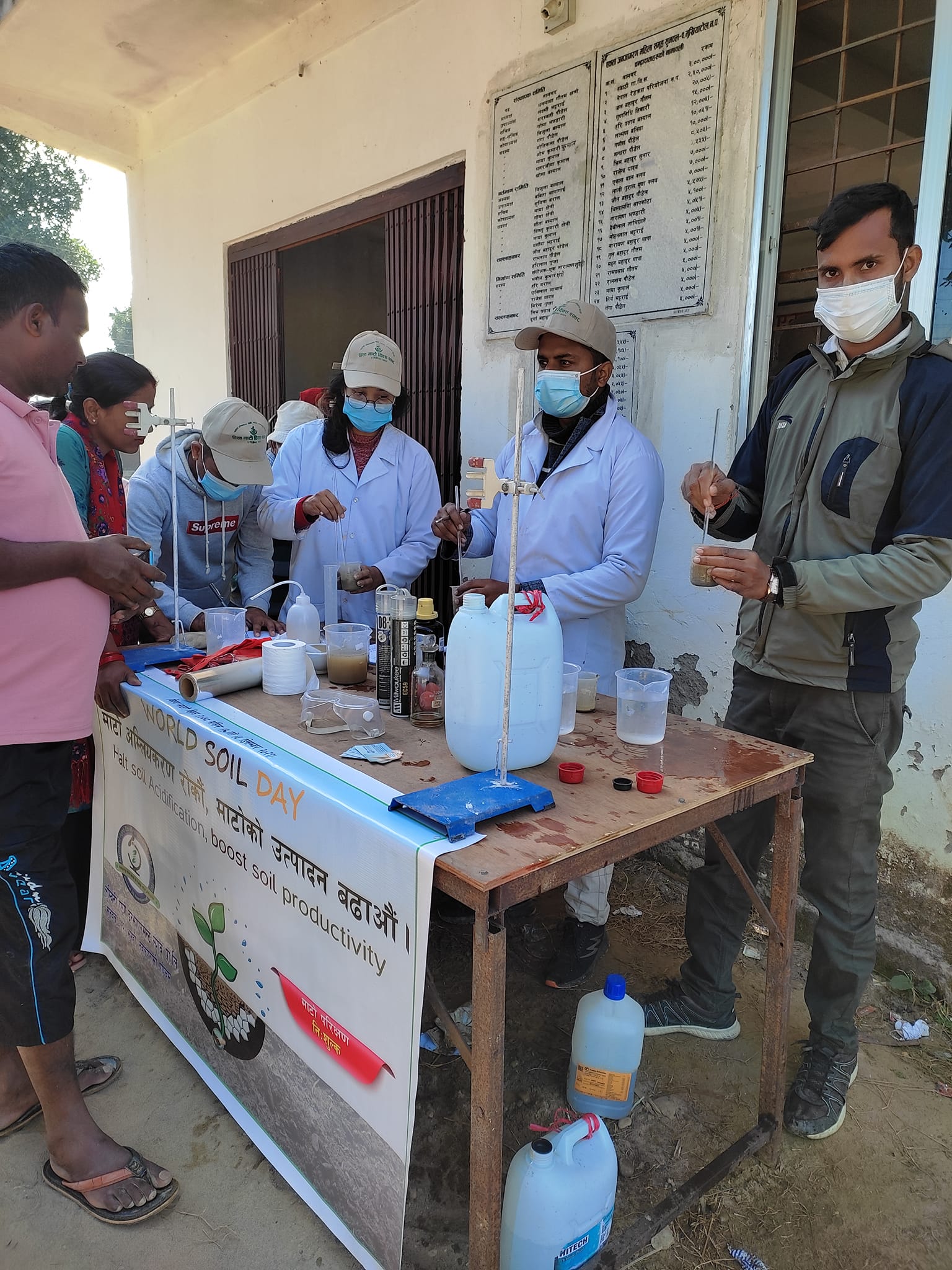
Agriculture remains the cornerstone of rural economies in Nepal, and the fertility and health of soils are vital to ensure long-term agricultural productivity. Recognizing this, Ramgram Municipality conducted an extensive soil testing program in 2081/2082 B.S. across over 400 fields, partnering with Lumbini Agro Environment Lab Pvt. Ltd. The report captures critical data on physical and chemical soil properties such as pH, electrical conductivity (EC), organic matter (OM), total nitrogen (N), phosphorus (P), potassium (K), and soil texture. These indicators help inform crop planning, fertilizer recommendations, and conservation strategies essential for building climate-resilient and economically productive farming systems.
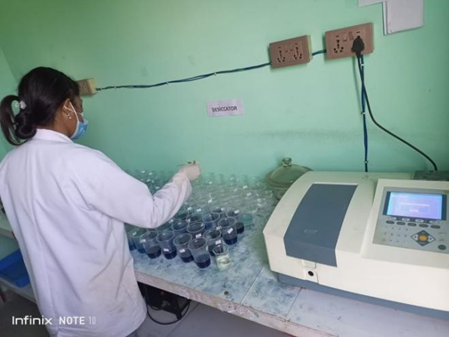
Picture: Soil Phosphorus Testing
1. Soil pH: Identifying Soil Acidity and Alkalinity Zones
Soil pH influences nutrient solubility and microbial activity, thus directly affecting plant health. The pH range in Ramgram’s soils spanned widely—from highly acidic (3.3 in Field B231) to strongly alkaline (8.5 in Field B46).
- Acidic soils (pH < 6.0) were common in southern and river-adjacent fields. These soils are prone to nutrient lock-up, especially phosphorus, and increased toxicity of elements like aluminum and manganese.
- Alkaline soils (pH > 8.0), particularly seen in northern fields, can reduce availability of iron, zinc, and boron, leading to stunted growth in crops.
Implication: The widespread variability underscores the need for localized soil amendments. Acidic soils require liming, while alkaline soils can benefit from elemental sulfur or organic compost that buffers high pH.
2. Electrical Conductivity (EC): A Measure of Soil Salinity
EC is an indicator of soil salinity. Excessive salinity hinders plant root water uptake, causing physiological drought even when water is available.
- The EC values ranged from a very low 0.007 dS/m (B95) to as high as 4.0 dS/m in fields like B225, B227, and B228, which are critically saline.
- Saline patches were mostly localized but can have devastating effects if unmanaged.
Implication: Such fields must be managed with salt-tolerant crops like barley or sugar beet and improved drainage to prevent salt buildup.
3. Organic Matter Content: The Life of the Soil
Organic matter improves water retention, cation exchange capacity, and supports microbial life. The majority of samples showed values between 2% and 4%, which is moderate.
- Fields like B11 (5.19%) and B1 (5.12%) demonstrated excellent organic matter, a sign of good composting or residue return practices.
- However, low OM fields, particularly below 2% (e.g., B19, B30), reveal potential degradation and need soil restorative practices.
Implication: Compost, green manure, cover cropping, and organic mulching should be prioritized to enhance soil structure and fertility.
4. Total Nitrogen: Fuel for Vegetative Growth
Nitrogen is essential for plant growth and chlorophyll formation. Ramgram’s soils displayed significant variation in nitrogen content, ranging from 0.036% to 0.204%.
- Many plots like B124, B286 exceeded 0.18%, which is favorable for leafy crops, vegetables, and cereals.
- Conversely, nitrogen levels below 0.1%, as seen in B259, imply a strong deficiency, limiting potential yield.
Implication: Nitrogen management should be guided by test data. Urea or organic alternatives (vermicompost, biofertilizers) can be applied in low-nitrogen zones. High-nitrogen areas should avoid over-application to reduce nitrate leaching.
5. Phosphorus: Root Growth and Energy Transfer
Phosphorus is vital for photosynthesis and energy transfer within plants. The available phosphorus in the soil varied dramatically, from as low as 13 kg/ha to above 100 kg/ha.
- High-P fields like B2 (118.51 kg/ha) and B27 (71.40 kg/ha) can support deep-rooted crops and legumes.
- Several fields, like B259 (15.66 kg/ha), showed critical phosphorus deficiency, likely due to years of crop mining without adequate replenishment.
Implication: DAP and single super phosphate (SSP) fertilizers should be applied only where phosphorus is deficient to avoid excess runoff into nearby water bodies.
6. Potassium: Regulating Water and Enhancing Resistance
Potassium regulates stomatal function and improves drought resistance.
- The potassium range was massive—from 53.76 kg/ha to 1854.72 kg/ha (B318).
- Many samples fell within the 200–400 kg/ha zone, which is generally adequate. Very high potassium fields must be balanced with adequate phosphorus and nitrogen to avoid nutrient imbalance.
Implication: Potash (MOP) fertilizers should be reserved for deficient fields only. Excess K can interfere with magnesium and calcium uptake.
7. Soil Texture: The Foundation of Management Choices
Soil texture determines water holding capacity, drainage, and root penetration.
- Sandy Loam and Sandy Clay Loam were predominant in central fields—these are well-drained but low in nutrient retention.
- Silty Clay Loam and Silty Clay soils dominate riverine and southern fields. These retain water and nutrients but are prone to compaction and waterlogging.
Implication:
- Sandy soils benefit from frequent irrigation and organic additions.
- Clay-rich soils should be managed with raised beds or contour plowing to prevent flooding and improve aeration.
Summary of Observations:
| Parameter | Range Observed | Recommendations |
| pH | 3.3 – 8.5 | Lime in acidic areas, sulfur in alkaline areas |
| EC | 0.007 – 4.0 dS/m | Drainage, gypsum for high EC soils |
| Organic Matter | 0.34% – 5.95% | Compost, green manures |
| Nitrogen | 0.036% – 0.204% | Urea/biofertilizers based on need |
| Phosphorus | 13 – 118.51 kg/ha | Apply DAP/SSP where needed |
| Potassium | 53.76 – 1854.72 kg/ha | MOP for low K, monitor high K zones |
| Texture | Silty Clay Loam, Sandy Loam, Sandy Clay Loam | Choose crops and irrigation accordingly |
Conclusion: A Call for Precision Farming in Ramgram
This soil analysis across hundreds of fields is more than just numbers—it’s a blueprint for sustainable agricultural development in Ramgram Municipality. The diversity in soil chemistry and texture confirms that “one-size-fits-all” agricultural practices are no longer viable. Precision agriculture—where inputs are tailored to actual field conditions—can help boost yield, reduce environmental degradation, and increase farmer income.
With proactive management, informed fertilizer use, and conservation agriculture practices, Ramgram can become a model municipality for soil health restoration and food security.