Sudip Paudel¹, Sujan Poudel¹, Sunil Chaudhary¹, Jharana Nepal²
¹PhD Scholar, Institute of Science and Technology (IOST), Tribhuvan University, Nepal
²PhD Scholar, Institute of Tibetan Plateau Research (ITP), Chinese Academy of Sciences (CAS), China
In the rapidly evolving technological landscape of the 21st century, Artificial Intelligence (AI) stands at the forefront of a global debate: Is it a catalyst for unlocking new dimensions of human creativity, or does it threaten to reduce the very essence of what makes creative endeavors uniquely human? Once considered the stuff of science fiction, AI has now made its way into art studios, music production houses, and design firms. With every passing day, its reach extends further into previously uncharted territories—fields that were traditionally dominated by human intuition and imaginative prowess.
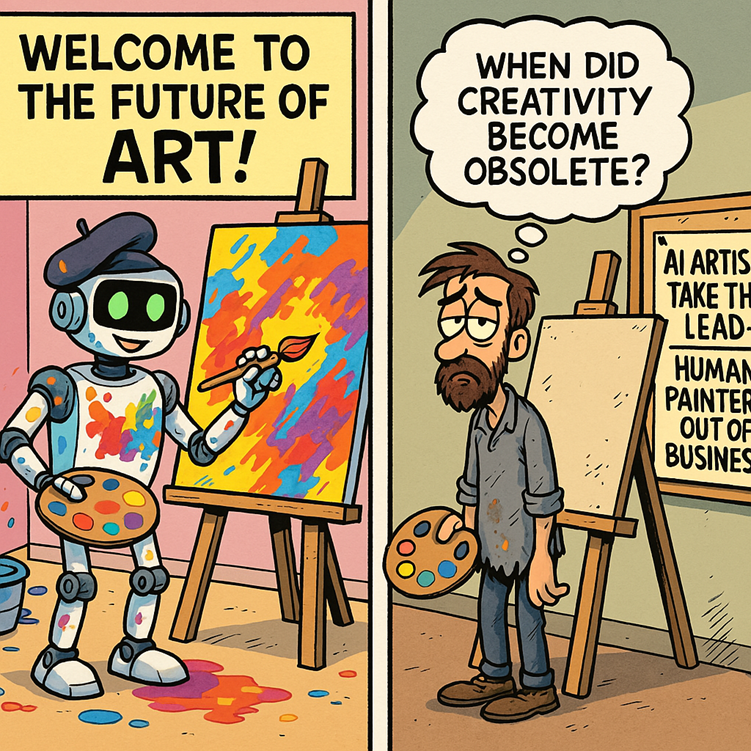
On the one hand, enthusiasts hail AI as a powerful tool capable of automating time consuming tasks, assisting in brainstorming sessions, and even generating entirely new forms of creative expressions. On the other, critics warn that it may displace human workers, shift the perceived value of human made art, and lead us toward a homogenized cultural landscape devoid of emotional resonance. This article will explore both sides of the conversation, drawing insights from centuries of creative evolution—from the Stone Age to the modern age—and examine how AI fits into the broader context of humanity’s creative legacy.
Defining Creativity: Rationalism Meets Romanticism
Before analyzing whether AI will enhance or diminish creativity, it’s vital to understand creativity’s conceptual underpinnings. According to Becker (2001), creative expression represents an “inner truth” or the “spirit” of a unique individual, implying that genuine creativity emerges from deeply personal experiences and inherent human qualities. This echoes a Romantic perspective on creativity, where innovation is seen as bubbling up from an “irrational unconscious”—the part of our minds fueled by emotions, intuitions, and raw imaginative power (Sawyer & Henriksen, 2024).
Contrastingly, the Rationalist viewpoint frames creativity as a product of conscious, deliberate, and highly intelligent processes. From this angle, new ideas are formed by methodically examining existing concepts and recombining them in novel ways. Both perspectives—Romanticism and Rationalism—highlight different aspects of human creative capacity. The Romantic viewpoint stresses intangible inspiration, while Rationalism focuses on thoughtful, systematic approaches to problem solving.
AI, in many ways, tries to emulate the Rationalist perspective by sifting through massive datasets and recognizing patterns far too complex for the human mind to handle swiftly. Yet, some argue that AI merely simulates creativity rather than truly experiences it. Questions remain whether this simulation can ever replicate the “spirit” behind genuine human creativity.
A Brief History of Human Creativity
Human creativity is not a modern invention. It has powered our evolution and sparked our innovations throughout history, shaping each epoch in unique ways. In the Stone Age—spanning up to around 3000 BCE—creative efforts were primarily directed toward survival. Hand axes, scrapers, and knives emerged as tools that fundamentally changed hunting and gathering. These early inventions demonstrated a spark of human ingenuity: the ability to see raw materials and transform them into something functional.
By the Iron Age (approximately 1200 BCE to 600 CE), creativity had taken on new forms with the development of sturdier weapons and agricultural tools. The forging of iron symbolized humanity’s ever expanding mastery over natural resources. Fast forward to the Industrial Revolution of the 18th and 19th centuries, and we see steam engines revolutionizing transportation and manufacturing. This period epitomized the synergy between creativity and technology—machines fueled by coal and steam replaced manual labor, while trains and ships bridged vast distances.
Then came the 20th century, characterized by automobiles, airplanes, and computers—innovations that once again redefined the boundaries of human capability. Each breakthrough, in its own era, represented a pinnacle of applied creativity. These inventions didn’t just happen; they were the result of the human mind’s ability to imagine possibilities and then bring them to life through rational design or serendipitous moments of inspiration.
The 21st Century: The AI Era
In the 21st century, we stand on the cusp of yet another revolutionary leap: the AI era. Machine learning algorithms, neural networks, and robotics have emerged as the newest frontiers for creative exploration. What once took a team of researchers years to accomplish can now be processed in minutes by specialized AI systems. For instance, data analysis—previously a tedious, time consuming procedure—can now be automated to yield insights at astonishing speeds. In fields like art, AI generated images have captured the public’s imagination, with machine generated paintings sometimes fetching significant sums at auctions.
Beyond art, AI’s influence spans fields such as manufacturing, medical diagnostics, music composition, and even creative writing. Natural Language Processing (NLP) models can compose poetry or outline entire short stories, while generative design software can produce engineering blueprints optimized for material use, cost, and efficiency. These tools, combined with robotics in manufacturing and the rise of 3D printing, open up a realm where creativity is no longer limited by human reaction times or oversight. Instead, we are starting to see a hybrid process: humans set the objectives and frame the problem, while machines run iterative experiments at a scale and speed that humans alone could never match. The result? Potentially rapid advancements in everything from architecture to medicine.
AI in Artistic Realms: Empowerment or Threat?
Nothing sparks debate quite like the impact of AI on traditionally “human” spaces such as art, music, and literature. Some artists praise AI based tools for saving them countless hours of labor, allowing them to explore new aesthetics and quickly iterate ideas. In graphic design, for example, AI can automatically adjust color palettes or generate geometric patterns, offering novel sources of inspiration. Authors employ AI assisted writing platforms to overcome writer’s block, while musicians experiment with AI driven composition software to create new sounds.
However, many creators remain wary. They argue that relying too heavily on AI can dilute the authenticity of the creative process, reducing art to an assembly of algorithmically derived patterns. Audiences, too, might question whether an AI generated painting or melody can match the emotional depth of a human made piece. Is there an intangible quality—an artistic spirit—that emerges only when the creator invests personal experiences, emotions, and cultural context into the work?
At the heart of the debate lies the concept of originality. AI models are trained on massive collections of prior works; they excel at reconfiguring existing elements. Yet can they truly originate something that is entirely new and not simply a sophisticated rearrangement of the past? This question remains unresolved, fueling both excitement and apprehension about the role AI will play in the future of the arts.
Creative Collaboration: Humans and Machines
One promising resolution to this tension lies in collaborative creativity. Rather than viewing AI as a rival, many experts propose harnessing it as a tool—a co-creator that augments the human imaginative process. Much like the steam engine allowed early industrialists to exceed the physical limitations of human and animal labor, AI can help modern creators surpass cognitive limitations, exploring vast design spaces in record time.
In this synergy, humans supply the emotional intelligence, contextual knowledge, and imaginative “leaps” that ground the creative act in meaning. The AI, meanwhile, offers computational brute force, advanced pattern recognition, and the capacity to generate numerous prototypes without fatigue. This partnership could usher in a golden age of creativity, where neither the machine nor the human alone could achieve the same breath taking results.
For instance, in architecture, an AI might quickly iterate hundreds of structural designs that meet specific engineering criteria, while an architect selects which design best resonates with the human element—beauty, cultural significance, and environmental harmony. In fine arts, an artist might begin with an AI generated concept and then add expressive strokes that capture personal experience. At its best, this model embraces the core strengths of both partners, unlocking forms of expression that neither could produce independently.
Fears and Realities of Job Displacement
One of the most pressing concerns surrounding AI’s growing influence is the fear of widespread job displacement, particularly in creative industries. Writers worry about AI generated articles, designers question their place in a world where logos can be automated, and photographers face competition from image generation algorithms that can produce photos of imaginary people or places at the click of a button. This anxiety mirrors the Industrial Revolution, when machines threatened to replace skilled labor, causing widespread social and economic disruption.
But if history is a guide, technology driven upheavals typically replace some roles while simultaneously generating entirely new ones. During the Industrial Revolution, factory based production eliminated certain artisanal jobs but led to the rise of new professions in engineering, manufacturing oversight, and technology development. Similarly, AI may automate certain tasks—like drafting base level sketches, generating content outlines, or performing routine photo editing—but it can also create demand for human specialties. Roles like AI ethics consultants, data curators, AI assisted project managers, and creative technologists have already emerged. Instead of uniformly displacing human creativity, AI might transform the job market in ways that push creative professionals to re skill and adapt—potentially discovering aspects of their craft that remain uniquely human and irreplaceable.
Shift in the Perception of Value
Technological changes often come hand in hand with shifts in how society perceives the value of creative work. When the laborious aspects of producing an artwork, such as fine detailing or colorizing, can be automated, does the public still value the end product in the same way? Some argue that mass adoption of AI in creative fields may diminish the “aura” of a piece if it’s too heavily AI generated, because part of art’s allure is the human effort, skill, and emotional investment behind it.
On the flip side, others contend that technological aids have been a part of creativity since time immemorial. From the earliest chisel to the modern day word processor, we’ve always leveraged tools to amplify our imaginative outputs. AI, while more sophisticated, is essentially an extension of this tradition. What may change is our collective appreciation for nuance. As AI augmented creations flood the market, the truly human touches—hand drawn imperfections, subtleties of emotional resonance, and culturally grounded perspectives—might gain new levels of appeal precisely because they stand out amid the algorithmic crowd. In this view, society shifts toward valuing not just the final product but also the human journey that led to it. This could ironically increase the appreciation for traditional, human centric crafts, even as AI tools become more widespread.
Emotional Resonance and the Human Spirit
A painting that moves us to tears, a novel that immerses us in new realities, a piece of music that resonates with our most intimate memories—these are the hallmarks of human creativity, tied to our emotional tapestry. Critics of AI driven creativity argue that while AI can mimic patterns of art or writing, it does not feel the human condition. It doesn’t rejoice, suffer heartbreak, or draw upon lived experiences that color its creations with an emotional authenticity. A key question arises: can something that does not experience the spectrum of human emotions ever truly replicate the soulfulness that captivates us in art?
Proponents of AI acknowledge this gap but suggest that the emotional imprint within AI generated work actually emerges from its human collaborators—those who set parameters, choose training data, and offer feedback. In other words, the emotional depth comes through a synergistic process, albeit one in which the AI is a tool. After all, even among human artists, not all creations reflect deep personal experiences. Some works are whimsical exercises or commercial commissions. Could it be that emotion, while pivotal in certain art forms, is not the sole litmus test for creativity’s value? As AI continues to evolve, we may discover the boundaries of how emotions can be interpreted, integrated, or partially simulated by machine processes.
Lessons from the Past: Evolution, Not Extinction
A striking lesson from history is that new technologies rarely eradicate human creativity; they reshape and expand its expressions. The Stone Age introduced rudimentary tools that elevated survival tactics. The Iron Age revolutionized warfare and agriculture. The Industrial Revolution mechanized production, freeing people to explore realms beyond brute force labor. The emergence of computers in the 20th century fundamentally transformed how we process information, giving rise to new art forms such as digital media, electronic music, and video games.
AI’s role in creativity is likely to follow a similar evolutionary pattern. Instead of leading to an outright extinction of human created art, AI stands to diversify the spectrum of possible creative expression. Artists, writers, and innovators who embrace AI as a sophisticated ally can scale their imaginations. They can prototype quickly, test ideas more thoroughly, and incorporate data insights that would be unattainable through manual methods alone. The result is a dynamic, expansive creative culture—though one that may demand continuous learning and adaptation.
The Human Edge: Emotion, Meaning, and Originality
Even in an AI saturated future, certain facets of creativity may remain uniquely human. Specifically, the capacity to infuse works with deeply personal meaning, cultural resonance, and genuine emotional expression could stay beyond AI’s full reach. While AI can emulate stylistic flourishes by analysing massive datasets, it does not have subjective experiences to draw upon—no childhood memories, heartbreaks, or transcendent joys that drive passionate creative acts. At least for now, these quintessentially human qualities are precisely what give artistic or innovative outputs their unique, vibrant spirit.
Moreover, truly ground breaking ideas often emerge from intuitive leaps that defy straightforward logic—moments of spontaneous inspiration or “eureka” realizations. While AI excels at pattern recognition and incremental innovation, it might struggle with that intangible spark of radical originality. From this perspective, the emotional and experiential core of creativity could remain distinctively human, ensuring that even the most advanced AI remains a complement, not a replacement, for the depth and richness of human creative expression.
Collaboration Over Competition: The Path Forward
The most promising future scenario envisions a partnership between humans and AI. Much like the synergy between data scientists and advanced analytics platforms, creativity could be propelled to new heights when both human intuition and machine intelligence work in tandem. In such a framework, AI takes on tasks where it excels: rapid prototyping, complex data analysis, and boundless pattern generation. Humans then bring context, interpretative skill, and emotional nuance—elements that anchor innovation in meaningful experiences.
As AI generated images, music, and narratives evolve, they can serve as springboards that spark human ingenuity. Writers could feed an AI system a theme or mood, receive multiple story outlines, and then sculpt the one that resonates most profoundly with human emotion. Painters and multimedia artists might rely on generative adversarial networks (GANs) for color experiments or new visual motifs, building upon them with personal flair. This environment underscores AI’s potential to enhance, rather than diminish, human creativity—provided we position it as a collaborator rather than a competitor.
The Debate Continues: Ethical and Cultural
Any shift of this magnitude also entails ethical, social, and cultural considerations. AI systems learn from massive datasets, which may contain biases or limited cultural perspectives, inadvertently perpetuating stereotypes or overshadowing minority voices. Creative works generated by AI might then reflect these biases, raising questions about equity, ownership, and representation. Furthermore, the democratizing effect of AI—where anyone with the right tools can produce sophisticated art—could erode traditional gatekeepers in the creative industries. While this might foster inclusivity, it also risks saturating the market with AI assisted outputs, making it harder for truly innovative voices to rise above the noise.
Another ethical quandary lies in authorship and accountability. If an AI is responsible for significant portions of a project, who truly “owns” the result? Laws and regulations surrounding AI generated intellectual property vary by jurisdiction, creating uncertainty for creators. Ultimately, the social and ethical dimensions of AI driven creativity will shape how fully it is embraced, regulated, or resisted by cultural and legal systems worldwide.
Takeaway Message: Balancing Innovation with Authenticity
From cave paintings to AI generated imagery, each era has witnessed a new form of creative expression that reshaped cultural and social structures. The rise of AI forces us to confront questions about what creativity really means: Is it purely a product of rational minds combining existing concepts, or does it require a Romantic spark of emotion and unconscious inspiration? The answer is likely a bit of both, with AI serving as an extension of the rational dimension while humans maintain that vital emotional core.
We face growing fears of job displacement among content creators, along with shifts in how society perceives “true” creativity. Yet these concerns can be addressed if we adopt a perspective of collaboration over competition. AI may be capable of churning out designs and decisions at scale, but human creativity remains essential for infusing art with emotion, meaning, and original thinking. By learning to work alongside AI—much like we once adapted to the steam engine and the assembly line—we can harness its potential to unlock even greater heights of innovation.
Conclusion: Embrace AI, Preserve the Human Spirit
In answering whether AI will enhance or diminish human creativity, it’s clear that both outcomes are possible. The deciding factor lies in how we choose to integrate AI into our creative workflows and cultural mindset. If we regard AI as a mere replication tool, seeking only to replace human inputs and lower costs, we risk losing the intimacy and authenticity that make human creativity so impactful. Artistic fields could become dominated by formulaic, data driven outputs with diminishing emotional or cultural resonance. However, if we embrace AI as a powerful ally—an augmenting tool that complements our inherent imaginative qualities—then it opens doors to creative expressions never before seen. Humans remain the ultimate source of meaning, cultural context, and emotive depth. AI might emulate aspects of creativity, but it cannot replicate the lived experiences that inspire genuine innovation. By partnering with AI, we can explore uncharted territory, tackle challenges of unprecedented complexity, and even rediscover the fundamental joys of creation. As technology rapidly advances, holding onto the human spirit behind true creativity is paramount. The future is not an either/or scenario; it is a collaborative landscape where humans and AI co create, fueling each other’s potential, expanding the boundaries of what we believe possible, and ensuring that creativity continues to evolve—and thrive—for generations to come.